Hey Democrats, what if we made the primaries good?

The Democratic primaries have been, in PoliSci terms, an ungodly shitstorm. First Iowa made a strong argument that democracy itself is a failed experiment. Then New Hampshire couldn’t decide between Pete Buttigieg or his emotionally abusive mother Amy and ended up just going with their lovable socialist grandpa. By the time people of color were allowed to vote in any real numbers, every nonwhite Democrat had dropped out (I’m not going to sit here and acknowledge T*lsi G*bbard).

So it got me thinking, what if the primaries were… good? Like, what if instead of a long, national waking nightmare, we had a system that allowed the best candidates to rise to the top without forcing the eventual nominee to kowtow to a few unrepresentative states?

As I see it, there are a few key problems to address:

  • A couple states currently play an outsized role in picking the nominee. Every cycle, candidates spend years flocking to Iowa, New Hampshire, Nevada, and South Carolina. The rest of us are lucky to get a few weeks of Super PAC ads and some cursory promises to never forget the great people of [state/commonwealth/territory]. It’s why corn subsidies are politically untouchable and why Elizabeth Warren is sending Tom Brady to the Las Vegas Raiders.
  • Those states look nothing like America. It’s breaking no ground to point out that New Hampshire and Iowa are overwhelmingly white and nonurban. But it’s still breathtaking to think about: in a nation that’s expected to be majority people of color by 2050, the most politically important states are 92% and 88% white respectively. Nevada and South Carolina certainly provide some much-needed diversity, but Iowa and New Hampshire set the tone; this year, the vast majority of candidates dropped out before Nevada and South Carolina even voted.
  • A national primary would heavily favor the biggest spenders. It’s tempting to ask why we can’t just have a single-day, 50-state primary to give us all an equal voice. But the reality is that unless we’re willing to commit to 100% publicly financed campaigns, a national primary would be more of a test of fundraising prowess and name recognition than anything. Picture Mike Bloomberg dropping a billion dollars on ads in the month before voting and walking away with a plurality of delegates. And as painful as it is, it’s useful to ask candidates to navigate a lengthy, multi-faceted primary because it gives the press and the public time to determine frontrunners based on actual votes and vet the candidates accordingly.
  • If we remove the elements of the process that winnow the field, we risk contested conventions. This is a big part of why the primary calendar is so disjointed and elongated. The expectation is that candidates will slowly drop out, giving us either a one-on-one fight (Obama–Clinton 2008, Clinton–Sanders 2016, Sanders–Biden 2020) or a coronation. If we democratize democracy too much, we’ll end up with chaos on the convention floor every four years.

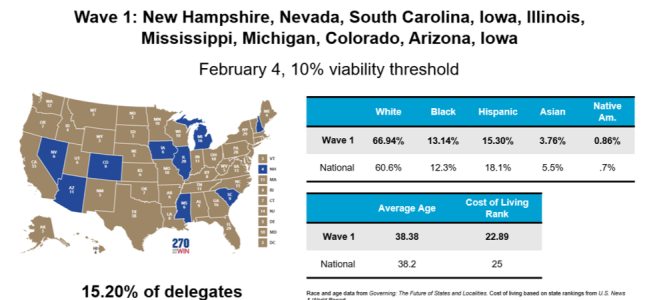
The solution, I believe, is a multi-state wave approach, in which each wave is intentionally similar to the nation as a whole in terms of race, age, and cost of living—and with a focus on regional parity. And I hope it goes without saying that this also means ending undemocratic caucuses in favor of true primaries.

The idea is that by grouping the states into waves we not only give more states a place of importance in the process, but also we can more easily give a voice to underrepresented groups. Each of the five waves would account for 15–20% of the total delegates—with the exception of Super Tuesday—to ensure candidates have no incentive to skip a wave they see as less favorable to them. Each wave would also have geographic diversity to prevent a candidate from sweeping to victory just because a region favorable to them voted first. But wherever possible, there are a few states in the same region in each wave, so that candidates low on funds or name recognition can more easily canvass multiple states at once.

The final consideration was how to avoid a contested convention. This is where things get a little less equal. The earlier voting states would have lower viability thresholds to earn delegates; these thresholds would gradually increase until the final wave is winner-take-all by state. The GOP already uses winner-take-all primaries to avoid brokered conventions, and there’s no reason Democrats can’t adopt this practice in the last wave as a final safeguard.


So, what would this look like in practice? A modest proposal is below.
Look at that, early voting states: you get to keep your place! The reality is that Iowa, New Hampshire, Nevada, and South Carolina are not inherently bad places to start. They’re relatively affordable to advertise in, they’re geographically disparate, and three of the four are swing-ish at minimum. They’re just incomplete. For this wave, I targeted a mix of low-cost states and states with large population centers to make sure that urban and suburban voices are heard. Illinois and Michigan, with their diverse metro areas and expansive rural geographies, offer a good cross-section. Mississippi and South Carolina give the Black Belt a voice. And Colorado, Arizona, and Nevada have above-average Hispanic and Native American populations. This wave is a bit whiter than the nation on the whole, but it’s dramatically better than Iowa and New Hampshire on their own—and crucially, six of the nine states are frequent or upcoming swing states.
Wave 2 would see far fewer states but slightly more delegates. The presence of these larger states so early both encourages nonviable candidates to drop out and gives higher population density locales (read: “places where people live”) more power. And in Wave 2, five out of six states are likely to be swing-ish in coming years. Where Wave 1 was whiter than the nation on average, Wave 2 has a higher percentage of Hispanic Americans, although it’s worth noting that the Texas Hispanic community (many of whom have roots pre-dating Texas’s entry into the United States) is quite different from the largely Cuban community in Florida. Hopefully, bringing these diverse states to the forefront of the process would force candidates to consider individual communities in their platforms, rather than broadly defined demographic groups. 
Super Tuesday is essentially a necessity due to California’s size and would likely be many candidates’ last stand. With a 20% viability threshold and large expensive states in play, any candidate who hasn’t caught fire after the first 14 states would be highly incentivized to drop out. California is obviously the big prize, but the Rust Belt, Northeast, Midwest, Deep South, Mid-Atlantic and Pacific Northwest are all represented. The West Coast states also provide an opportunity for Asian American voters to be counted. Making it through Super Tuesday would be expensive, but with nearly a full month between Wave 2 and Wave 3, candidates would have time to assess whether they got the fundraising boost needed from the first two waves to continue on.
Wave 4 comes just two weeks after Super Tuesday and features another massive delegate prize that comes with a hefty price tag: New York. The Northeast on the whole is more represented in Wave 4 than elsewhere, but candidates who focus only on the East Coast would miss out: the Great Plains, Mountain West, Southwest and West Coast are all included too. And Wave 4 features three of the five states with the highest percentages of Native peoples; hopefully, by consolidating these states in one wave, these communities can finally get the attention they deserve. With a 20% viability threshold, any campaigns hanging on past their due could come up empty and be forced out.
Many years, the contest will be over by this point and the presumptive nominee can clinch a delegate majority in this wave. That’s why many states that are traditionally less important in the general election—and are full of Republicans—make up the final wave. But in years when the nomination is coming down to the wire, larger states like New Jersey, Tennessee and Missouri could play kingmaker. And the biggest consideration for Wave 5 is the move to a winner-take-all format. Imagine a frontrunner who struggled through a crowded primary and gets to Wave 5 with 40–45% of delegates; a winner-take-all final stage provides the opportunity to secure an outright majority and avoid a contested convention.

All in all, this process would still not be perfect. The heartland could claim it’s sequestered to Wave 5, while crucial states like New York and California don’t vote until midway through the process. The accelerated timeline—designed to spare voters from months of redundant debates—could make things tough for insurgent candidates. Not to mention, this does nothing to address voter suppression and the disruptive force of outside spending.


But giving voters from so many of the disparate communities that make up America a more equitable role in the electoral process will surely create a more democratic process. And with any luck, it’ll help Democrats answer the whole “electability” question a little easier and a little faster, by letting truly representative elections decide.

How To Spend Spring Break Now That You Can’t Travel

If you’re like many people, you’ve made the difficult decision this week to cancel your spring break trip to some warm, exotic destination. This is disappointing, to be sure, but also leaves you with an unexpected free week. How are you going to spend it? Here are a few suggestions from your friends at Left On Read:

  1. Masturbate vigorously
  2. Continue masturbating
  3. Unfortunately, there’s nothing else to do besides unyielding self-gratification
  4. Just keep masturbating, kid

Picking a Campaign Song for Every Candidate Left

A great campaign song can transform an election. Bill Clinton had “Don’t Stop” by Fleetwood Mac, Barack Obama used “Signed, Sealed, Delivered, I’m Yours” by Stevie Wonder to great effect, and who can forget the old-timey background music from Birth of a Nation that Donald Trump presumably blared?

But when it comes to trademark songs, the current crop of candidates seems to be vacillating between incredibly blessed and just remarkably cursed choices. That’s not good enough. With that in mind, we set out to help. Here are the songs each of the Democrats contending for the nomination and also Mike Bloomberg should use this campaign season:

Bernie Sanders – Everything I Wanted, by Billie Eilish. Oh sure, he’ll promise you everything you say you want. Healthcare. Education. Jobs. A planet to inhabit. But what if, hear me out, it’s actually a socialist nightmare?!?! Not what you’d think???!!! If you’re being honest!!! (This article is a sponsored post provided by the Mike Bloomberg campaign. “Bloomberg 2020: You’re Gonna Get What You Deserve, You Little Shits.”)

Joe Biden – Ocean Eyes, by Billie Eilish. Say what you want about Joe Biden. No seriously, go ahead and talk about this and this and hell, even this. While you do that, I’m just gonna be staring into those baby blues

Elizabeth Warren – No Time To Die, by Billie Eilish. This isn’t a rallying cry for a comeback. Nor is it about any of the song’s lyrics. It’s more just a general symmetry between the song and the candidate. Like, they both seemed like they were gonna be hits. And people generally don’t hate either of them, exactly. But, like, did you remember this song existed? Probably not. Did anyone in Nevada remember that Liz killed the CEO of Wells Fargo? Certainly not.

Mike Bloomberg – Bad Guy, by Billie Eilish. This one’s fun because Mike Bloomberg’s NYPD illegally surveilled the city’s Muslim population and threw black men against the wall for fun. He is, in most modern ethical frameworks, a bad guy. It’s the titular role!

Pete Buttigieg – idontwannabeyouanymore, by Billie Eilish. Look, we were all about it for a minute. Abolish the electoral college? Yes daddy. Unpack the Supreme Court? Um, ok king! Parlay white male midwestern mediocrity into the most powerful position alive? I’M TRYING. But the more we got to know him, the less we wanted to be just like Mayor Pete. We’ll stick to more inspirational role models for now, like that girl who was selling feet pics to save Australia <3. 

Amy Klobuchar – All The Good Girls Go To Hell, by Billie Eilish. I will maintain until my dying day that Amy Klobuchar should have leaned into the ice queen aesthetic from day one. No one wants a nice senator who promises to win back Trump counties; we want a firebreather who will sucker punch your mom for not saying “God rest his soul” after mentioning Paul Wellstone. Also, this song includes the line “Peter should know better,” which is a pretty good summary of every time Amy opens her mouth on the debate stage. Case closed.

Tom Steyer – You Should See Me In A Crown, by Billie Eilish. Idk idk, he’s rich or something. I honestly don’t get this dude’s deal. He’s the second richest billionaire in the race and his plan seems to be siphoning off just enough support from Biden (???) to finish third in one of the first four states? This seems like a dumb plan. This campaign is dumb. 

Email Delay Apologies, in Order of How Much You Hate the Recipient

1. “I’m so sorry for the delay. I thought I replied already.” This is an okay person. You may genuinely be sorry.

2. “Sorry for the delay. Just catching up on my inbox.” You feel nothing for this person. You do feel mildly remorseful about not replying sooner, but you also intentionally ignored this email when you saw it.

3. “Hey, sorry. Just getting to this.” You don’t care for this person. If given the choice between a phone call and in-person meeting, you push for email.

4. “Sorry, just seeing this.” This person annoys you and you have intentionally put off replying for as long as possible. You may have considered leaving a negative review about this person on their company’s Glassdoor profile.

5. “Sorry for the wait. The first email somehow wound up in my spam folder.” Fuck this person. You have literally masturbated to the idea of this person being removed from your life. Nobody’s email ever “winds up” in your spam folder. This is you subtly telling them you think they are trash.

Here’s the precocious child on the train that we’re avoiding eye contact with this week

Name: Caden
School: Dalton (no ‘the’; no ‘School’ nor ‘Prep’; only bright, sensitive minds)
Eye Contact: Disturbingly strong
Reading: Anna Karenina: The Graphic Novel
College Savings Plan: Larger than your student loans
Listening to: Been getting into Belle & Sebastian’s early discography recently
Nanny: Has more degrees (2.5) than you (.5)

What if we taxed weed to pay for reparations?

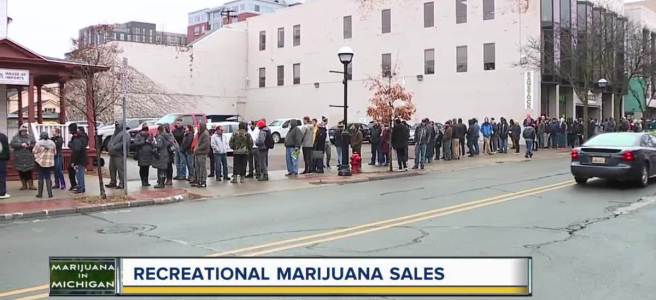
On December 1, 2019, Michigan legalized recreational marijuana. That day, I saw a line that stretched at least two city blocks filled with people waiting to buy. It was one of the most diverse (racially, economically, Kid-Rock-meets-Bernie-Sanders-y) crowds I could remember seeing in Ann Arbor since the city’s last Hash Bash. Ann Arbor’s dispensaries sold out of product for the next several days after it was legalized.   

Weed has always been practically, if not actually, legal for white, relatively affluent people like me. But I never stood around in the freezing cold for an hour to get it while listening to people tell stories about how their dad had to come bail them out after they were caught possessing in the 70s.

In Michigan, the tax on weed is 16%—a 10% excise tax on adult-use products and a 6% sales tax. In the first week alone, Michigan generated $270,000 in tax revenue off weed sales, and the state is projecting to rake in around $150 million per year starting in 2021. And that money goes to some good causes: researching the medical benefits of marijuana, funding schools, improving roads, and putting money in state and local coffers. And some states are taxing weed even more heavily than Michigan is, although they might start lowering taxes to avoid turning the weed enthusiasts of today into the Grover Nug-quists of tomorrow.

But there’s a better use of this money: reparations. Let’s call this “The Case for Reeferdations.” Actually, don’t, but thanks for considering it. 

The War on Drugs has resulted in profoundly unequal outcomes along racial lines. As Michelle Alexander, author of (required reading, or at least required referencing) The New Jim Crow put it, “Nothing has contributed more to the systematic mass incarceration of people of color in the United States than the War on Drugs.” And mass incarceration is just one recent entry in the history of American racism that stretches back to our original sin. Racist and classist drug policing left deep wounds everywhere from housing to the right to vote, and it’s time to start paying up—and to use funds from marijuana legalization to do so. 

This isn’t a new idea. Evanston, Illinois has proposed using its weed revenue for race-based reparations in the form of direct payments for its residents to purchase homes or pursue higher education, two areas where the effects of racism remain particularly salient. And governments experimenting with reparations to correct past harms is not unprecedented. Chicago, for example, created a $5.5 million fund for victims of police torture, while the U.S. issued a formal apology and $20,000 in compensation to people of Japanese descent who were forced into internment camps.

There are legitimate, salient reasons to not do this. For one, using marijuana tax revenues for race-based reparations could further exacerbate the racialization of drug use. And reparations raise extremelythorny and hardtoresolveissues. But, as a counterpoint, the Redfordations program in Watchmen seemed to be working out… about as well as you could expect in America? 

Estimates vary, but it’s not crazy to say that legal marijuana will be generating $30 billion per year in sales in the near future. That’s more than the NFL’s revenue—a product that actually is dangerous. At a 5% tax rate devoted to our hypothetical reeferdations, we’d be generating around $1.5 billion per year. 

What could we do with this money? Far smarter people have thought much harder about this than me. But here are just the first five ideas that come to mind: 

  • Appropriate the $12 million needed, under H.R.40, “to study and consider a national apology and proposal for reparations for the institution of slavery, its subsequent de jure and de facto racial and economic discrimination against African-Americans, and the impact of these forces on living African-Americans, to make recommendations to the Congress on appropriate remedies, and for other purposes.” Immediately. 
  • Direct payments. Cost estimates vary, and even our hefty $1.5 billion/year is nowhere close to the (very roughly) $400 billion to $2.6 trillion owed to make economic amends for past injustices. But it never hurts to start, and depending on how trickly your economic views are, maybe a rising economic tide could lift all boats. 
  • Make more targeted direct payments. Perhaps in the form of pension payments to low-level drug offenders caught up in the war on drugs. Or maybe we take that money and use it to equalize the amount of school spending per student throughout the nation. 
  • Contribute to Bryan Stevenson’s Equal Justice Initiative, the Southern Poverty Law Center, and any other legal organization combating racial inequity in the legal system. Hiring more public defenders wouldn’t hurt either.
  • Invest in housing, education, and businesses to build up the generational wealth of Americans who had it systematically stripped throughout the course of our history. 

We’re not going to paper over the racial crimes perpetrated by America over the last several centuries by cutting checks in the next few years. But it would be a worthwhile use of our tax dollars to take money from a product that represents one of the most harmful elements of American public policy and put it toward a productive result that can at least start the process of making amends.

Your Job Is (Probably) Meaningless—And That’s Okay

Theodore Roosevelt once said, “Far and away the best prize that life has to offer is the chance to work hard at work worth doing.” Sadly, you’ve probably got a consolation prize. Yep, your job is probably worthless—but that’s totally fine! 

For years, we’ve grown up under the spectre of companies like Uber, Facebook, and Google championing a new era of work culture. In exchange for nap pods and catered lunches and beer on tap, corporate employees have been told they are supposed to care about their work. More than that, they have been convinced that prioritizing actions that blur the lines between work and home, like bringing your “whole self” to work (I’ve cut off a pinky and put it in my freezer—take that, boss man) and taking your pets to the office, are important facets of workplace culture and their own satisfaction. As people have allowed corporations to consume more and more of their lives, they have encountered some cognitive dissonance in the form of a question: Why would I let something unimportant take up 75% of my waking day? To that, our brains (and start-up Internal comms teams everywhere) have come up with a rationalization: Because your work matters. You are making a difference

The truth, in the words of the 21st century’s Teddy Roosevelt, Lizzo: Bitch, you lie. 

Now, you’re probably thinking, “You’re wrong, anonymous writer! I am extremely passionate about B2B solutions for transnational shipping and fulfillment logistics.” That may be true—but it does not make your job any less inconsequential. Whether you’re at a glorified ad company helping create a useless moonshot (shoutout to Google Wallet and Google Hangouts), monetizing extremely personal information for a megalomaniac, or at one of the 7.5 billion companies cutting out the middleman and bringing those savings to customers like you and me, what you do probably means nothing and concerns nobody other than the people you share your office with. In fact, here is a full list of the jobs that matter to people who aren’t you:

  • Doctor
  • Teacher
  • Dentist (not you, Orthodontists)
  • Nursing Home Caretaker
  • Civil Rights Lawyer
  • First Responder
  • Ice Cream Truck Driver

That’s it. That’s everybody. 

This isn’t to say you aren’t important. You are extremely important. You can affect change with your money and your time and your daily disposition. The important thing is that your totally useless, not-at-all-valuable job does not interfere with that. In fact, your real job, as the wonderful, important person you are, is to stay employed at your meaningless job and soak them for all they’re worth. Take as much money as you can spending as little time at the office as you can. Fuck the weekend hackathons. Fuck the optional corportate retreats. Fuck ‘em all. Get as much money as you can on the bare minimum of your time, and then bring your happiness and fortune to the rest of the world. 

Work is an exchange of services (your time) for value (goddamn cash). There is a reason it’s called a work-life balance: Your work and your life are totally distinct things. That’s a great thing too—I heard what your company does is totally useless.

What’s an acceptable level of cheating on a crossword puzzle?

Acceptable

  • Looking up the name of somebody you have no reason to know
  • Using Google maps to confirm if the Wichita-to-Omaha direction is ENE or NNE
  • You’ve never heard of that word
  • You’ve heard of that word, but honestly it’s a pretty bullshit answer/clue
  • Asking your parent/partner/friend/bus-seat mate
  • [Check Word]
  • You need to keep your NYT Crossword streak alive

Unacceptable

  • Needing to plug in your phone because you’ve used up all your battery looking up questions
  • You’ve already looked up the same clue’s answer for three previous puzzles
  • You’re looking up the name of an actor in a movie you’ve seen
  • You know in your heart of hearts that you do/should know the answer.
  • Asking your ex/professor/ex professor/professor ex
  • [Check Puzzle]
  • You’re competing for leaderboard position on the NYT Mini

I’m Just A Boy, Standing In Front Of A Girl, Angrily Defending My Sports Gambling Addiction

Look, I get it. I get why you’re unhappy that I had to take you to a “seedy and gross” Irish pub for Valentine’s Day because I didn’t have the money to take you to the nice restaurant where I had made a reservation. And I know you’re especially unhappy knowing that I had the money, but lost it because I put $300 on a three-game NCAA basketball parlay.

But don’t forget: I’m just a boy. Standing in front of a girl. Angrily defending my sports gambling addiction.

First of all, don’t blame ME for Louisville absolutely shitting into its slippers against Georgia Tech. I assure you, anyone who knows fucking anything about college basketball would take that bet.

I’m also not sure you quite understand that if I had won this bet, I would have made $1,400. I’m sure that tapas restaurant I made a reservation at is just fantastic, but if Louisville had figured out how to score against the fucking anemic Georgia Tech defense, I could have taken you to SPAIN. I could have gotten you all the tapas you fucking want.

It isn’t MY fault that Louisville decided to choke on ass for no reason. The only thing that’s my fault here is that I promised you we would get goddamn tapas and had you craving a stupid glass of fucking sangría all week. Though you clearly didn’t crave it that much, because the guys at McDuffy’s said they could probably figure out how to whip together a sangría, but you suddenly weren’t interested anymore.

Whatever. It’s fine. I’m sorry you got food poisoning. I did tell you the fish and chips weren’t a safe bet, but that still sucks. I guess we’ve both learned a thing or two about safe bets this week.