Hey Democrats, what if we made the primaries good?

The Democratic primaries have been, in PoliSci terms, an ungodly shitstorm. First Iowa made a strong argument that democracy itself is a failed experiment. Then New Hampshire couldn’t decide between Pete Buttigieg or his emotionally abusive mother Amy and ended up just going with their lovable socialist grandpa. By the time people of color were allowed to vote in any real numbers, every nonwhite Democrat had dropped out (I’m not going to sit here and acknowledge T*lsi G*bbard).

So it got me thinking, what if the primaries were… good? Like, what if instead of a long, national waking nightmare, we had a system that allowed the best candidates to rise to the top without forcing the eventual nominee to kowtow to a few unrepresentative states?

As I see it, there are a few key problems to address:

  • A couple states currently play an outsized role in picking the nominee. Every cycle, candidates spend years flocking to Iowa, New Hampshire, Nevada, and South Carolina. The rest of us are lucky to get a few weeks of Super PAC ads and some cursory promises to never forget the great people of [state/commonwealth/territory]. It’s why corn subsidies are politically untouchable and why Elizabeth Warren is sending Tom Brady to the Las Vegas Raiders.
  • Those states look nothing like America. It’s breaking no ground to point out that New Hampshire and Iowa are overwhelmingly white and nonurban. But it’s still breathtaking to think about: in a nation that’s expected to be majority people of color by 2050, the most politically important states are 92% and 88% white respectively. Nevada and South Carolina certainly provide some much-needed diversity, but Iowa and New Hampshire set the tone; this year, the vast majority of candidates dropped out before Nevada and South Carolina even voted.
  • A national primary would heavily favor the biggest spenders. It’s tempting to ask why we can’t just have a single-day, 50-state primary to give us all an equal voice. But the reality is that unless we’re willing to commit to 100% publicly financed campaigns, a national primary would be more of a test of fundraising prowess and name recognition than anything. Picture Mike Bloomberg dropping a billion dollars on ads in the month before voting and walking away with a plurality of delegates. And as painful as it is, it’s useful to ask candidates to navigate a lengthy, multi-faceted primary because it gives the press and the public time to determine frontrunners based on actual votes and vet the candidates accordingly.
  • If we remove the elements of the process that winnow the field, we risk contested conventions. This is a big part of why the primary calendar is so disjointed and elongated. The expectation is that candidates will slowly drop out, giving us either a one-on-one fight (Obama–Clinton 2008, Clinton–Sanders 2016, Sanders–Biden 2020) or a coronation. If we democratize democracy too much, we’ll end up with chaos on the convention floor every four years.

The solution, I believe, is a multi-state wave approach, in which each wave is intentionally similar to the nation as a whole in terms of race, age, and cost of living—and with a focus on regional parity. And I hope it goes without saying that this also means ending undemocratic caucuses in favor of true primaries.

The idea is that by grouping the states into waves we not only give more states a place of importance in the process, but also we can more easily give a voice to underrepresented groups. Each of the five waves would account for 15–20% of the total delegates—with the exception of Super Tuesday—to ensure candidates have no incentive to skip a wave they see as less favorable to them. Each wave would also have geographic diversity to prevent a candidate from sweeping to victory just because a region favorable to them voted first. But wherever possible, there are a few states in the same region in each wave, so that candidates low on funds or name recognition can more easily canvass multiple states at once.

The final consideration was how to avoid a contested convention. This is where things get a little less equal. The earlier voting states would have lower viability thresholds to earn delegates; these thresholds would gradually increase until the final wave is winner-take-all by state. The GOP already uses winner-take-all primaries to avoid brokered conventions, and there’s no reason Democrats can’t adopt this practice in the last wave as a final safeguard.


So, what would this look like in practice? A modest proposal is below.
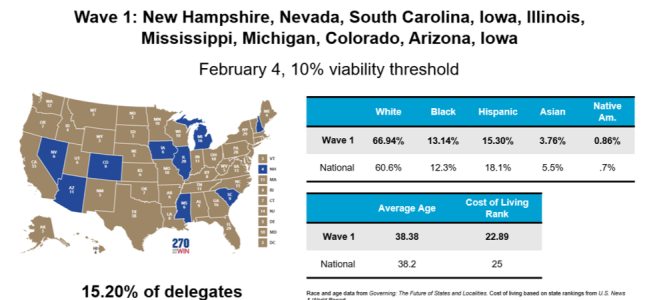
Look at that, early voting states: you get to keep your place! The reality is that Iowa, New Hampshire, Nevada, and South Carolina are not inherently bad places to start. They’re relatively affordable to advertise in, they’re geographically disparate, and three of the four are swing-ish at minimum. They’re just incomplete. For this wave, I targeted a mix of low-cost states and states with large population centers to make sure that urban and suburban voices are heard. Illinois and Michigan, with their diverse metro areas and expansive rural geographies, offer a good cross-section. Mississippi and South Carolina give the Black Belt a voice. And Colorado, Arizona, and Nevada have above-average Hispanic and Native American populations. This wave is a bit whiter than the nation on the whole, but it’s dramatically better than Iowa and New Hampshire on their own—and crucially, six of the nine states are frequent or upcoming swing states.
Wave 2 would see far fewer states but slightly more delegates. The presence of these larger states so early both encourages nonviable candidates to drop out and gives higher population density locales (read: “places where people live”) more power. And in Wave 2, five out of six states are likely to be swing-ish in coming years. Where Wave 1 was whiter than the nation on average, Wave 2 has a higher percentage of Hispanic Americans, although it’s worth noting that the Texas Hispanic community (many of whom have roots pre-dating Texas’s entry into the United States) is quite different from the largely Cuban community in Florida. Hopefully, bringing these diverse states to the forefront of the process would force candidates to consider individual communities in their platforms, rather than broadly defined demographic groups. 
Super Tuesday is essentially a necessity due to California’s size and would likely be many candidates’ last stand. With a 20% viability threshold and large expensive states in play, any candidate who hasn’t caught fire after the first 14 states would be highly incentivized to drop out. California is obviously the big prize, but the Rust Belt, Northeast, Midwest, Deep South, Mid-Atlantic and Pacific Northwest are all represented. The West Coast states also provide an opportunity for Asian American voters to be counted. Making it through Super Tuesday would be expensive, but with nearly a full month between Wave 2 and Wave 3, candidates would have time to assess whether they got the fundraising boost needed from the first two waves to continue on.
Wave 4 comes just two weeks after Super Tuesday and features another massive delegate prize that comes with a hefty price tag: New York. The Northeast on the whole is more represented in Wave 4 than elsewhere, but candidates who focus only on the East Coast would miss out: the Great Plains, Mountain West, Southwest and West Coast are all included too. And Wave 4 features three of the five states with the highest percentages of Native peoples; hopefully, by consolidating these states in one wave, these communities can finally get the attention they deserve. With a 20% viability threshold, any campaigns hanging on past their due could come up empty and be forced out.
Many years, the contest will be over by this point and the presumptive nominee can clinch a delegate majority in this wave. That’s why many states that are traditionally less important in the general election—and are full of Republicans—make up the final wave. But in years when the nomination is coming down to the wire, larger states like New Jersey, Tennessee and Missouri could play kingmaker. And the biggest consideration for Wave 5 is the move to a winner-take-all format. Imagine a frontrunner who struggled through a crowded primary and gets to Wave 5 with 40–45% of delegates; a winner-take-all final stage provides the opportunity to secure an outright majority and avoid a contested convention.

All in all, this process would still not be perfect. The heartland could claim it’s sequestered to Wave 5, while crucial states like New York and California don’t vote until midway through the process. The accelerated timeline—designed to spare voters from months of redundant debates—could make things tough for insurgent candidates. Not to mention, this does nothing to address voter suppression and the disruptive force of outside spending.


But giving voters from so many of the disparate communities that make up America a more equitable role in the electoral process will surely create a more democratic process. And with any luck, it’ll help Democrats answer the whole “electability” question a little easier and a little faster, by letting truly representative elections decide.

Picking a Campaign Song for Every Candidate Left

A great campaign song can transform an election. Bill Clinton had “Don’t Stop” by Fleetwood Mac, Barack Obama used “Signed, Sealed, Delivered, I’m Yours” by Stevie Wonder to great effect, and who can forget the old-timey background music from Birth of a Nation that Donald Trump presumably blared?

But when it comes to trademark songs, the current crop of candidates seems to be vacillating between incredibly blessed and just remarkably cursed choices. That’s not good enough. With that in mind, we set out to help. Here are the songs each of the Democrats contending for the nomination and also Mike Bloomberg should use this campaign season:

Bernie Sanders – Everything I Wanted, by Billie Eilish. Oh sure, he’ll promise you everything you say you want. Healthcare. Education. Jobs. A planet to inhabit. But what if, hear me out, it’s actually a socialist nightmare?!?! Not what you’d think???!!! If you’re being honest!!! (This article is a sponsored post provided by the Mike Bloomberg campaign. “Bloomberg 2020: You’re Gonna Get What You Deserve, You Little Shits.”)

Joe Biden – Ocean Eyes, by Billie Eilish. Say what you want about Joe Biden. No seriously, go ahead and talk about this and this and hell, even this. While you do that, I’m just gonna be staring into those baby blues

Elizabeth Warren – No Time To Die, by Billie Eilish. This isn’t a rallying cry for a comeback. Nor is it about any of the song’s lyrics. It’s more just a general symmetry between the song and the candidate. Like, they both seemed like they were gonna be hits. And people generally don’t hate either of them, exactly. But, like, did you remember this song existed? Probably not. Did anyone in Nevada remember that Liz killed the CEO of Wells Fargo? Certainly not.

Mike Bloomberg – Bad Guy, by Billie Eilish. This one’s fun because Mike Bloomberg’s NYPD illegally surveilled the city’s Muslim population and threw black men against the wall for fun. He is, in most modern ethical frameworks, a bad guy. It’s the titular role!

Pete Buttigieg – idontwannabeyouanymore, by Billie Eilish. Look, we were all about it for a minute. Abolish the electoral college? Yes daddy. Unpack the Supreme Court? Um, ok king! Parlay white male midwestern mediocrity into the most powerful position alive? I’M TRYING. But the more we got to know him, the less we wanted to be just like Mayor Pete. We’ll stick to more inspirational role models for now, like that girl who was selling feet pics to save Australia <3. 

Amy Klobuchar – All The Good Girls Go To Hell, by Billie Eilish. I will maintain until my dying day that Amy Klobuchar should have leaned into the ice queen aesthetic from day one. No one wants a nice senator who promises to win back Trump counties; we want a firebreather who will sucker punch your mom for not saying “God rest his soul” after mentioning Paul Wellstone. Also, this song includes the line “Peter should know better,” which is a pretty good summary of every time Amy opens her mouth on the debate stage. Case closed.

Tom Steyer – You Should See Me In A Crown, by Billie Eilish. Idk idk, he’s rich or something. I honestly don’t get this dude’s deal. He’s the second richest billionaire in the race and his plan seems to be siphoning off just enough support from Biden (???) to finish third in one of the first four states? This seems like a dumb plan. This campaign is dumb. 

Pop Punk Hits Remade for the 2020 Election

“Coercing a Foreign Government into Damaging a Political Rival Is the Most Fun a Girl Can Have Without Taking Her Clothes Off” — Panic! At The Disco ft. Rudy Giuliani

“I’m Not Okay (I Promise…SERIOUSLY)”  — Mike Bloomberg

“Check Yes, Vladimir” — Donald Trump

“Lifestyles of the Rich & Hopeless” — Tom Steyer

“The Middle America” — Amy Klobuchar

“A Little Less Sixteen Candles, A Little More Intricate Policy Planning” — Elizabeth Warren

“I’m Just a Kid (And I Was a Mayor)” — Pete Buttigieg 

“Thnks fr th Obma Yrs” — Joe Biden

“Angry Deb8er Boi” — Bernie Sanders

“I Will Do (LITERALLY) Anything” — Hillary Clinton

“Welcome to the White Parade” — The Republican National Committee 

“Wake Me Up When the Primaries End” — Everybody

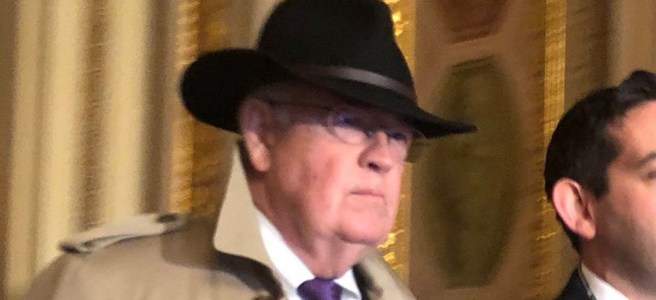
The Starr-torial Report: Why did Ken Starr decide to wear such a stupid-looking cowboy hat to the impeachment trial?

Left on Read has substantial and credible information supporting the following grounds to possibly think this hat was befitting of one of America’s most sanctimonious blowhards:
Maybe it was his favorite hat to wear while out on his fishing expeditions in the 1990s. Plus, when your office happens to leak details of the Whitewater investigation to the press, you can always use your hat to catch ten gallons worth of seepage.
Then again, maybe he picked a wide-brim hat to conceal himself from the culture of sexual violence on Baylor’s campus that propagated under his watch. Can’t be taken down in a probe into executive nonfeasance if you were too busy tilting your goofy-ass hat back so you could see in front of you without turning your neck up!
Or who’s to say. Maybe he just wanted to go with a more retro look.

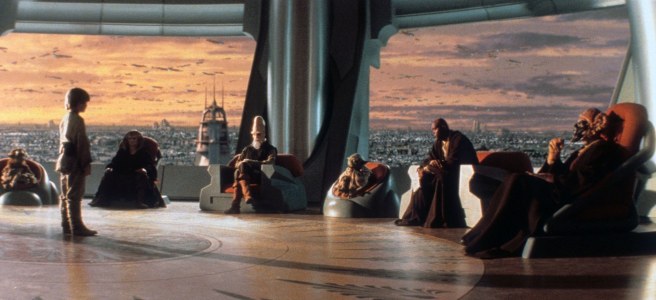
WOW: George Lucas’ Jedi Council Predicted the Obama Administration YEARS Before the 2008 Election

Okay guys, check this out. This. Is. Mindblowing. 

Star Wars fans know how much attention and detail George Lucas poured into his art. But I’m guessing that most of you didn’t get this MAJOR easter egg hidden in the prequel trilogy. It turns out that Lucas, by portraying the Jedi Council in Episodes I through III (not to mention other assorted ~not canon~ stories), totally NAILED the Obama administration that would roll into office more than THREE YEARS after the release of Revenge of the Sith

Pretty wild, right? Here’s how we know: 

  • In the prequels, the Jedi Council is portrayed as a group of high-minded and well-meaning libs. A veritable “team of rivals,” if you will. But just as Secretary of States Clinton and Kerry were unable to foresee or prevent the rising trend of nationalism across the globe, the Jedi—despite strong moral superiority and favoritism from the media—were oblivious to the return of the Sith Order happening in their midst.
  • Emperor Palpatine never gained the popular vote, but, like Mitch McConnell, he commanded a disproportionate majority in the Senate. 
  • Yoda is an obvious stand-in for Joe Biden. I mean, both are old, neither can communicate well, and they both just absolutely love reminding you of all the great people they knew in the past. But ask them to stand up and actually do something for once? Whoooaaa, buddy, let’s not take things too fast. 
  • It goes without saying that the Droid Army is a portentous commentary on the tenuous morality of drone warfare. I mean, duh. 
  • I’m not sure how Lucasfilm pulled this one off, but if you analyze the script closely, you can tell that Mace Windu is an amalgamation of all the Crooked Media guys. Just as Mace keeps reminding you that he’s a great swordsman, Jon Favreau, Jon Lovett, and Tommy Vietor keep reminding you that they were in the Obama administration. And let’s not forget that Windu and all those podcasters literally failed to predict the rise of Trumpism/an emperor happening right in front of them, and then were pretty ineffectual at trying to stop it. 
  • Mitt Romney, like Jar Jar Binks, negligently allowed a racist to spew racist theories in support of his campaign and/or empowered an evil lord through democratic channels.

The Democratic Candidate We Aren’t Talking About

It seems that the Democrats can’t unite behind one candidate. Bernie’s too old, Biden’s too creepy, Warren’s too lefty, Mayor Pete’s married to an aspiring Instagram influencer, Klobuchar’s too angry, Michael Bennet’s apparently still in the race. But for some reason, nobody is talking about the perfect candidate, one that encompasses all the most salient liberal values: my labrador retriever, Gator.

Let’s start by addressing the elephant in the corner: yes, Gator is a male. I know. I want to see America’s first female president in my lifetime, too, and I will gladly support any woman with the Democratic nomination who isn’t named Tulsi Gabbard. But this election is more important than any in post–Civil War American history, and we need a candidate who will win and bring the liberal agenda to the executive branch, and then bring the branch back to me. Gator is that candidate.

Gator would be a spectacular steward of Democratic policies. As a survivor of a harrowing wave of government-subsidized canine genital mutilation that struck suburban Colorado in the 1990s, he is adamantly pro-choice. He believes in decreasing unemployment rates, as long as every household has at least one person at home at all times. He pledges to increase funding to municipal services and has a plan to have a fire hydrant on every street corner by 2022. And he’s great on foreign policy, too; just last week, he said in an interview with Michael Barbaro that the assassination of Qasem Soleimani will almost certainly result in a cyberattack reprisal, proliferation of Iranian nuclear programs, and a general destabilization of the Middle East.

As important as his policies are, he also needs to be reliable during the general election, because nobody knows what sorts of curveballs will come careening at him from the right. That’s perhaps the most compelling argument in favor of Gator: he is absolutely gaffe-proof, because we put him down ten years ago this April.

I already know the next word to come out of your mouth: “Electability.” I appreciate the strategic mindset, but, to be frank, the mere discussion of electability here is a little offensive. Do you really think America isn’t ready for a president that is overweight, a dog, and a decade into the afterlife? Look, we simply cannot decide the Democratic candidate based off our impressions of what center-left and center-right voters want! It’s time to take control of the liberal movement and elect a candidate who really embodies this nation, and also the dwindling vestiges of my childhood.

I mean, he’s a yellow lab. How much more American can you get? He is the dead dog equivalent of a prosperous small business owner whose parents came over from Eastern Europe with only the clothes on their backs. But even more agreeable to Americans. Think a prosperous small business owner whose parents emigrated from Northern Europe.

I’m not going to argue that Gator is perfect. He was dumb as a box of hammers, and he really lost control of his bowels in his sunset years. But think about all the upsides! He has no opposable thumbs, so he can’t tweet. He doesn’t even know what a quid pro quo is. He could get a White House dog and look after him as his own dog.

Democrats, the choice is clear. Vote Gator for President in 2020. And for VP, honestly I think Steve Bullock.

The Post–Cold War Order’s Dirty Thirty

It’s been thirty years since the end of the Cold War. How does the post–Cold War world order’s own emotional journey of its childhood and adulthood compare with our own:

1989–1994/96: First 5–7 years great, everything is happy.

1997–1999: At some point between 8 and 10, we lose our innocence for the first time—walking in on parents/realizing you sort of allowed ethnic cleansing to happen in southeastern Europe.

2000–2003: Early teenage years—a lot of questions, awkwardness and growth.

  • If a traumatic event happens during that time period, you might never fully recover from it (parents divorcing, 9/11)

2003–2007: Mid-late teenage years—you start to develop really strong political opinions without realizing that they’re bad political opinions.

  • Patriot Act, The Surge, etc.
  • Reading the Communist Manifesto for the first time

2008–2011: College/Recession—Your financial circumstances worsen significantly due to a predatory economic system. You possibly contract an STD/swine flu.

2011: You graduate college and have a short-lived spurt of hope and optimism/Arab Spring.

2012–2016: Your optimism comes crashing back to earth as you learn to navigate the real world a little bit. Get a job, maybe move to a new city. Save up a little cash. You think you’re starting to figure things out.

2016–2019: Quarter-life crisis. Brexit, Trump, etc. You’re not sure you’re doing anything right, so perhaps you just say “fuck it” and make drastic, systemic changes. You scuttle things that were once really important to you (election integrity). For a brief moment, you reflect on the way you’ve treated women in your past. And suddenly you’re really into foreign films?

2020: You feel a big milestone coming up, so you try to find some minute accomplishment you can achieve so you feel like you’ve done something by 30. You don’t even succeed in doing that.

Pwoké Bowls: Refreshing Bowls for the Performatively Woke

Welcome to Pwoké Bowls, proudly serving performatively woke twists on a Hawaiian classic since 2008. Here’s this week’s offerings of the dishes that we’re not going to follow through on: 

Kamal-ahi Harris

  • Californian mild rice 
  • Sweet onions
  • Exculpatory-document-shredded carrots
  • Avocado
  • Item discontinued for lack of customer interest

Momé Bloggé 

  • White rice
  • Sashimi
  • Facebook post in Comic Sans MS about own courage in talking to people of other races while on the Buttigieg campaign trail.
  • Sliced radish
  • Hawaiian roll

Oberge-don’t-fall-for-it v. Hodges

  • Syrupy sweet soy sauce
  • Grating-Scalia-Dissent ginger
  • Drizzled with a light, hollow pastiche that won’t protect your broader rights to be free from discrimination in any meaningful way
  • Edamame
  • Upgrade to a size XL serving of Anthony Kennedy’s self-aggrandizement

The Choomwagon

  • Green onions
  • Snowflake triggerfish
  • Comfortably living with the legacy of Obama’s deportation policy and reliance on drone warfare
  • Pineapple
  • Toasted, organically sourced hemp seeds

Ally & AJ

  • Handbag hot sauce
  • Gochugaru
  • Trail of tumblr posts that cite bell hooks
  • Yellowfin tuna
  • JK Rowling Clapback Cucumber Water

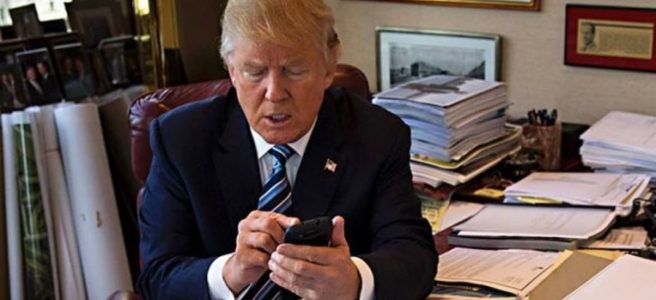
Headlines We’d Definitely See If Trump Literally Just Tweeted All The Racial Slurs He Knows

Journalists have been at the front lines of countless pitched battles during the Trump administration, bringing light to corruption and transparency to government. But also, they did this

So it’s worth asking: how would they handle their greatest test of all? How would our beloved free press respond if the president tweeted “ATTENTION: I’m gonna tweet out all the racial slurs I know (THREAD 1/)” and then proceeded to do just that? We have some ideas:

  • “In latest racial controversy, backers see Trump exercising free speech” – The New York Times
  • “Barr: Kanye said he could” – The Wall Street Journal
  • “#StandWithTrump trends as thousands tweet racially tinged epithets in solidarity” – The Washington Post
  • “Dems fret free speech controversy puts Massachusetts in play for 2020” – Politico
  • “Racist country’s racist president tweets racist things” – BBC
  • “COURAGE: Pres. Trump takes on corrupt civil rights industry” – Fox News
  • “Obama’s hip hop barbeque STILL didn’t create any jobs” – Fox Nation
  • “I…worked on this story for a year…… and he… he just tweeted it out” – www.krassenblog.woke.com 
  • “Good.” – Breitbart
  • “Undaunted by the Trump supporter we saw on the freeway last week, we bravely condemn Trump’s tweets” – Deadspin
  • “I mean, let’s at least hear him out” – Financial Times editorial board
  • “YASSSS KWEEN: Hillary issues epic clapback, calls on users to report Trump tweets to proper authorities” – www.resistancemamas.blogspot.com
  • “Celtics practice ends six minutes early” – The Boston Globe
  • “Opioids now account for 100% of county deaths” – Youngstown Herald

Love Actually Isn’t NOT About Brexit and Trumpism

Love Actually Isn't NOT About Brexit and Trumpism

Love Actually is a heartwarming tale about people finding heterosexual love in a post-9/11 global order. But, as we start another holiday season, it’s important to remember that the Christmas classic also isn’t not about the rising trend of nationalism, alt-conservatism, and retrenchment from the international, pluralistic values we once held as dear as Emma Thompson. Here’s why: 

  • A globalist cuck (Colin Firth), hopelessly constrained by his effeminacy (turtleneck sweaters), is cast out of England and into the arms of the Continent (Aurélia). 
  • Meanwhile, the virile Hugh Grant becomes infatuated with the white female body (Natalie) and the small-town England she represents (octopus boy). This nationalistic impulse culminates in the prime minister putting his nation ahead of its commitment to foreign allies (Billy Bob Thornton). 
  • A philandering snake-oil salesman wins over Wisconsin (sex-god Colin).
  • The old way is dying (Liam Neeson’s wife), and fake news is propagating (Martin Freeman’s adult film).
  • Not to mention the underlying paranoia about foreign influence, which causes borders to reify and security concerns to escalate (Jojeen Reed running through an airport to send off an immigrant as she’s returning to her home nation). 
  • It’s probably too obvious to bear repeating, but Mia’s “dark corners for doing dark deeds” is a patent head-nod to 4chan. 
  • Laura Linney, much like an England that’s growing increasingly frustrated with the EU’s flagging economies, is tired of dealing with the constant needs of her sick brother (Spain/Greece).
  • The deep state is always watching (wedding videographer) and communicates in nefarious ways (cue cards).